
Blog
Tire Shipping: Complete Guide for Distributors

Oct
Moving tires from manufacturing facilities to distributors across borders requires specialized logistics knowledge and careful planning. Whether you're shipping a single pallet of passenger car tires or multiple containers of commercial truck tires, understanding the nuances of tire shipping can significantly impact your bottom line and customer satisfaction. From selecting the right freight mode to navigating customs documentation and packaging requirements, tire distributors face unique challenges that demand both strategic thinking and operational excellence.
Understanding Tire Shipping Modes and Cost Drivers
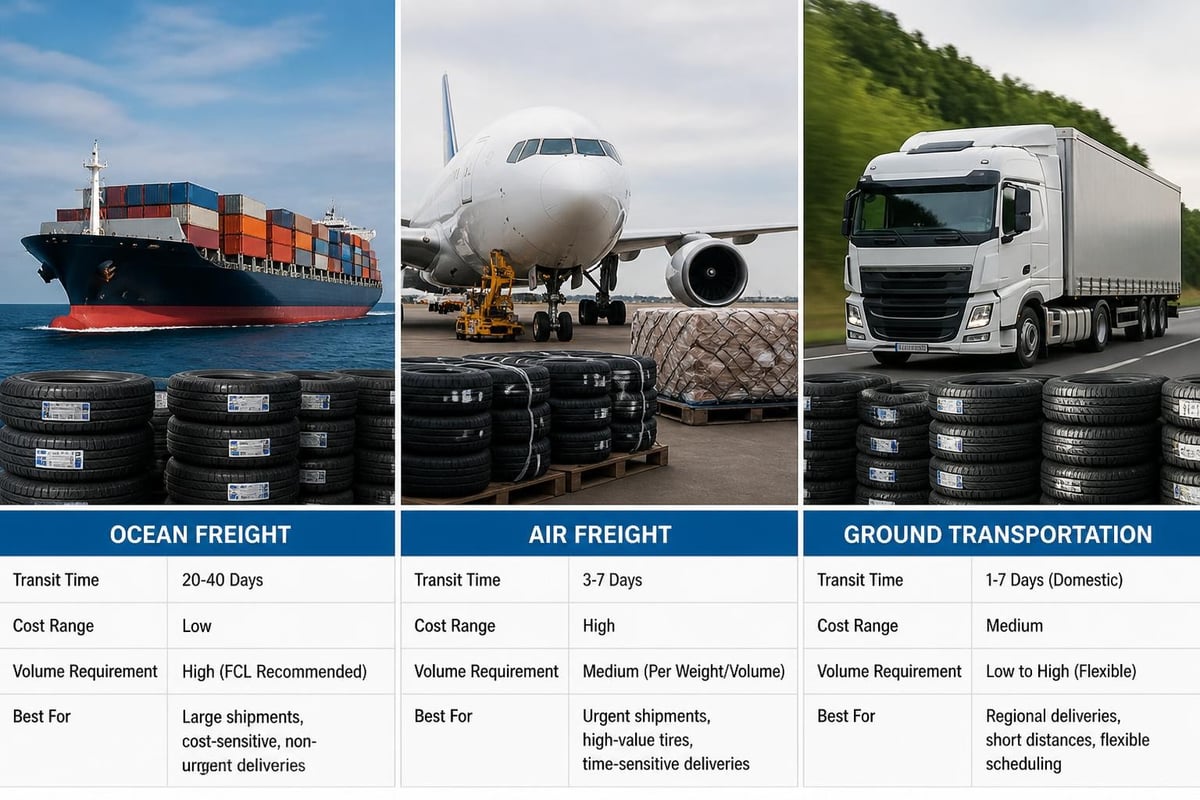
Tire shipping encompasses several distinct transportation methods, each with specific advantages depending on volume, destination, and urgency. The three primary modes-ocean freight, air freight, and ground transportation-offer different trade-offs between speed and cost efficiency.
Ocean Freight for Container Loads
Ocean freight remains the most economical option for shipping large volumes of tires internationally. Full Container Load (FCL) shipments provide the best per-unit cost when distributors can fill a 20-foot or 40-foot container. A standard 40-foot high-cube container can accommodate approximately 800-1,000 passenger car tires or 200-250 commercial truck tires, depending on size and stacking configuration.
Less-than-Container Load (LCL) shipping allows smaller distributors to share container space, though per-unit costs increase due to consolidation and deconsolidation fees. Transit times for ocean freight typically range from 15-45 days depending on origin and destination ports, making advance planning essential for inventory management.
Key factors affecting ocean freight costs:
- Port-to-port distance and routing
- Container size and type (standard vs. high-cube)
- Peak season surcharges (typically August-October)
- Fuel adjustment factors
- Port congestion and dwell time
Air Freight for Urgent Shipments
When time-sensitive orders demand rapid delivery, air freight offers transit times of 3-7 days for most international routes. However, the cost premium is substantial-typically 5-10 times higher than ocean freight on a per-kilogram basis. Air shipping proves most economical for high-value specialty tires, emergency replacement stock, or small sample orders.
Airlines classify tires as general cargo, though oversized OTR tires may require special handling and incur dimensional weight charges. The volumetric weight calculation (length × width × height ÷ 5,000 for most carriers) often determines the billable weight since tires are relatively lightweight for their volume.
Ground Transportation and Regional Distribution
For domestic shipments and regional distribution within continental markets, ground freight offers the optimal balance of speed and cost. Less-than-Truckload (LTL) carriers handle pallet quantities of tires with delivery times of 1-5 days depending on distance. Full Truckload (FTL) shipments become cost-effective when you can fill a 53-foot trailer with approximately 2,500-3,000 passenger tires or 500-600 commercial truck tires.
Tire shipping via ground carriers requires attention to freight class, which determines LTL pricing. Tires typically fall into freight classes 55-85 depending on density and value, with proper classification essential for avoiding reclassification fees and billing adjustments.
Packaging Standards and Protection Requirements
Proper packaging protects tires from damage during transit while optimizing space utilization and meeting carrier requirements. The packaging approach varies significantly based on tire type, size, and shipping method.
Passenger and Light Truck Tire Packaging
Passenger car radial (PCR) tires and light truck tires are commonly shipped in several configurations. Individual tire wrapping with polyethylene film protects tread patterns from contamination and prevents rubber-to-rubber contact that can cause surface degradation. Manufacturers typically bundle tires in sets of four or five, secured with steel or polyester strapping.
Palletization improves handling efficiency and reduces damage risk. A standard 48" × 40" pallet accommodates 30-40 passenger tires when stacked vertically, though horizontal stacking (laying tires flat) may be required for certain tire sizes to maintain load stability. Stretch wrap applied to the entire pallet unit secures the load and provides additional weather protection.
| Tire Type | Tires per Pallet | Stacking Method | Pallet Height |
|---|---|---|---|
| Passenger 13"-15" | 35-40 | Vertical | 68-72" |
| Passenger 16"-18" | 28-32 | Vertical | 68-72" |
| Light Truck | 20-25 | Vertical/Mixed | 72-80" |
| SUV/Crossover | 24-28 | Vertical | 70-76" |
Commercial and OTR Tire Shipping Preparation
Larger commercial truck tires and off-the-road (OTR) tires require different handling approaches due to their weight and dimensions. Semi truck tires are typically shipped standing upright on the tread, either individually or in pairs, secured to pallets or wooden skids with heavy-duty strapping.
OTR tires used in mining, construction, and agricultural applications present unique challenges. These massive tires-some exceeding 12 feet in diameter and weighing several thousand pounds-require specialized equipment for loading and securing. Many OTR tires ship individually in custom wooden crates or on reinforced platforms designed for their specific dimensions.
The UPS Service and packaging guidelines provide detailed specifications for maximum weight and size limits, though most commercial carriers have similar restrictions that necessitate freight shipping for larger tire sizes.
International Shipping Documentation and Customs Compliance
Cross-border tire shipping demands meticulous attention to documentation and regulatory compliance. Missing or incorrect paperwork causes costly delays, storage fees, and potential fines at customs checkpoints.
Essential Shipping Documents
Every international tire shipment requires a core set of documents that facilitate customs clearance and regulatory compliance:
- Commercial Invoice – Itemized listing of tire quantities, descriptions, unit values, and total shipment value
- Packing List – Detailed breakdown of package dimensions, weights, and contents by pallet or container
- Bill of Lading – Contract between shipper and carrier specifying terms, liability, and delivery instructions
- Certificate of Origin – Declaration of manufacturing country, often required for preferential duty treatment
- Import License – Required by certain countries that restrict tire imports or mandate pre-approval
Additional documentation may include quality certificates, fumigation certificates for wooden packaging materials (ISPM-15 compliance), and safety data sheets (SDS) if tire dressing or sealants are included.
Harmonized Tariff Classification
Accurate tariff classification is critical for determining import duties and ensuring customs compliance. Tires fall under Chapter 40 of the Harmonized System (HS), with specific codes based on construction type, size, and intended use.
Common HS codes for tire shipping:
- 4011.10 – New pneumatic tires, of rubber, for passenger cars
- 4011.20 – New pneumatic tires, of rubber, for buses or lorries
- 4011.61-4011.69 – Agricultural and construction vehicle tires
- 4011.70 – Motorcycle tires
- 4012.90 – Solid or cushion tires
Misclassification can result in incorrect duty assessment, customs holds, and potential penalties. Working with experienced customs brokers familiar with tire shipping helps ensure proper classification and valuation.

Regulatory Considerations for International Tire Distribution
Beyond standard customs procedures, tire shipping involves specific regulations that vary by destination market and tire type. Understanding these requirements prevents shipment rejections and ensures market access.
Quality and Safety Certifications
Many countries require tires to meet specific safety and performance standards before allowing import and sale. European Union markets demand ECE (Economic Commission for Europe) R30 or R54 certification depending on vehicle category. The United States requires Department of Transportation (DOT) compliance, with each tire bearing a DOT identification number that traces manufacturing location and date.
Our Semi Truck Tires from Thailand come with both DOT and ECE certification, ensuring they meet international quality standards for distribution across North American and European markets. These dual certifications streamline the import process and expand market opportunities for distributors.
Additional certifications may include ISO quality management documentation, test reports for load capacity and speed ratings, and compliance with regional noise emission standards. Maintaining organized certification files accessible during customs clearance accelerates the approval process.
Environmental Regulations and Waste Tire Movement
The transboundary movement of used or waste tires faces strict environmental regulations under international agreements. The Basel Convention guidelines on waste pneumatic tires establish protocols for cross-border shipment of end-of-life tires, particularly when shipped for recycling or energy recovery.
Several jurisdictions prohibit import of used tires entirely or require special permits and inspections. The European Tyre & Rubber Manufacturers Association recommendations outline industry positions on tire circularity and waste management that influence regulatory frameworks across EU member states.
When shipping new tires, maintaining clear documentation proving the tires are unused and intended for commercial sale prevents misclassification as waste material. This distinction is particularly important when shipping retreaded or remolded tires that might be mistaken for used products.
Cost Optimization Strategies for Tire Distributors
Effective tire shipping management directly impacts profit margins, especially for distributors operating on wholesale pricing models. Several strategic approaches can significantly reduce freight expenses while maintaining service reliability.
Consolidation and Volume Planning
Timing orders to achieve full container loads provides the most substantial cost savings in ocean freight. Rather than shipping partial containers multiple times per month, distributors can consolidate orders into monthly or bi-monthly FCL shipments, reducing per-unit freight costs by 40-60% compared to LCL rates.
For distributors unable to fill containers independently, partnering with other buyers in the same destination region enables shared FCL shipments. This approach maintains the cost benefits of container shipping while providing more frequent delivery cycles than individual LCL shipments.
Volume consolidation checklist:
- Forecast demand 90-120 days ahead for ocean freight planning
- Coordinate orders with other product lines to fill containers
- Negotiate volume commitments with manufacturers for better freight terms
- Consider using freight forwarders who consolidate multiple clients' shipments
Freight Forwarder Selection and Negotiation
Freight forwarders specializing in tire shipping bring valuable expertise in routing, documentation, and carrier relationships. Their consolidated buying power often secures better rates than distributors can negotiate independently, particularly for LCL shipments and complex multi-modal routes.
When evaluating forwarders, request detailed quotes that break down all cost components: ocean freight, terminal handling charges, customs brokerage, documentation fees, and destination delivery. This transparency allows accurate comparison and reveals hidden costs that inflate total landed cost.
The Freightos freight shipping guide offers comprehensive information on booking procedures and cost factors that apply across different freight modes, helping distributors make informed carrier selections.
Managing Transit Time and Inventory Planning
Tire shipping lead times significantly impact inventory management and customer service levels. Distributors must balance the cost advantages of slower, less expensive shipping methods against the carrying costs of holding larger safety stock to cover extended transit periods.
Transit Time Variables
Published transit times represent port-to-port or terminal-to-terminal movement and often exclude significant additional time for inland transportation, customs clearance, and final delivery. A "30-day" ocean freight shipment may actually require 45-50 days from manufacturer's warehouse to distributor's facility when accounting for:
- Inland transportation from factory to origin port (2-5 days)
- Port processing and container loading (2-4 days)
- Ocean transit (15-30 days depending on route)
- Destination port processing and customs clearance (3-7 days)
- Final delivery to warehouse (1-3 days)
Seasonal factors introduce additional variability. Peak shipping seasons around Chinese New Year, Golden Week, and the pre-holiday retail build-up create port congestion that can extend transit times by 1-2 weeks. Weather events, labor actions, and equipment shortages add further unpredictability.

Safety Stock Calculations
Effective inventory planning for tire distributors accounts for both demand variability and supply chain uncertainty. The safety stock formula considers average demand during lead time, standard deviation of demand, and desired service level:
Safety Stock = Z-score × √(Lead Time) × Standard Deviation of Demand
For tire distributors using ocean freight with 45-day lead times, maintaining adequate safety stock prevents stockouts without excessive inventory carrying costs. Many distributors adopt a dual-sourcing strategy, maintaining 80% of inventory through economical ocean freight while reserving air freight capacity for unexpected demand spikes or supply interruptions.
Risk Management and Cargo Insurance
Tire shipments face various risks during international transit, from physical damage and theft to vessel delays and port strikes. Comprehensive risk management combines proper insurance coverage with preventive measures that minimize exposure.
Cargo Insurance Options
Standard carrier liability provides minimal protection, typically limited to $0.50-$2.00 per pound for domestic shipments and even less for international freight under the Hague-Visby Rules. Given that commercial truck tires can retail for $300-$800 each and specialty OTR tires reach thousands of dollars, carrier liability coverage proves woefully inadequate.
All-risk cargo insurance policies protect against physical loss or damage from external causes during transit, typically covering 110% of invoice value to include freight costs and profit margins. Annual policies cost approximately 0.3-0.6% of insured value for established routes, with higher rates for high-risk destinations or first-time shipments.
| Coverage Type | Typical Cost | What's Covered | Exclusions |
|---|---|---|---|
| Carrier Liability | Included | Minimal damage | Most scenarios |
| Named Perils | 0.15-0.30% | Listed events only | Unlisted causes |
| All-Risk | 0.30-0.60% | Physical loss/damage | Delay, inherent vice |
| Warehouse-to-Warehouse | 0.40-0.75% | Full door-to-door | Willful misconduct |
Loss Prevention Best Practices
Insurance provides financial recovery but cannot fully compensate for customer dissatisfaction, lost sales opportunities, and operational disruption from damaged or delayed shipments. Preventive measures reduce claim frequency and insurance costs:
- Inspect containers before loading to identify damage or contamination
- Document pre-shipment condition with detailed photographs
- Use tamper-evident seals on containers and verify seal integrity at destination
- Require carriers to provide proof of proper tie-down and securing methods
- Select established carriers with strong safety records and modern equipment
Regular review of shipping claims identifies patterns that may indicate carrier problems, inadequate packaging, or handling issues requiring corrective action.
Working with Customs Brokers and Clearance Agents
Customs clearance represents a critical control point in tire shipping where delays can cascade into inventory shortages and disappointed customers. Professional customs brokers provide specialized knowledge that accelerates clearance while ensuring regulatory compliance.
Broker Selection Criteria
Licensed customs brokers handle tariff classification, duty calculation, documentation review, and regulatory compliance on behalf of importers. Their expertise proves particularly valuable when shipping to new markets or dealing with complex product classifications.
When selecting a customs broker for tire shipping, evaluate their experience with Chapter 40 HS codes, familiarity with tire-specific regulations (DOT markings, safety standards), and knowledge of preferential trade agreements that may reduce duty costs. Brokers with established relationships at destination ports often expedite clearance through informal networks and process knowledge.
Communication capabilities matter equally. Brokers should provide real-time shipment tracking, proactive alerts about documentation issues, and rapid response to clearance holds or examination requests.
Preferential Trade Agreements
Free trade agreements (FTAs) and preferential trade arrangements can significantly reduce or eliminate import duties on tires when origin requirements are met. Common agreements affecting tire shipping include:
- USMCA (United States-Mexico-Canada Agreement) – Eliminates duties on qualifying tires traded between member countries
- ASEAN Free Trade Area – Reduces tariffs among Southeast Asian nations
- EU Trade Agreements – Various agreements with partner countries offering preferential rates
Qualifying for preferential duty treatment requires proper origin documentation and compliance with rules-of-origin criteria that vary by agreement. Manufacturers and distributors should maintain detailed records of tire production location, material sourcing, and substantial transformation to support origin claims.
The USPS Postal Explorer packaging standards while primarily focused on domestic mail, illustrate the level of detail regulators expect in shipping documentation-a principle that extends to international customs procedures.
Technology Solutions for Shipment Tracking and Management
Modern tire distributors leverage technology platforms to manage the complexity of international shipping, from booking confirmation through final delivery. These systems improve visibility, reduce administrative burden, and enable proactive problem resolution.
Transportation Management Systems
Transportation Management Systems (TMS) centralize freight booking, documentation, tracking, and payment across multiple carriers and shipping modes. For tire distributors managing regular shipments from OTR TIRE THAI manufacturing facilities to global markets, TMS platforms provide:
- Rate shopping across carriers to identify optimal cost-service combinations
- Automated documentation generation with pre-populated shipper and consignee data
- Real-time tracking with milestone notifications and exception alerts
- Freight audit and payment processing to catch billing errors
- Analytics dashboards showing trends in transit time, costs, and carrier performance
Cloud-based TMS solutions have made enterprise-grade capabilities accessible to mid-sized distributors, with monthly subscription pricing that scales with shipment volume.
Track and Trace Capabilities
End-to-end visibility into tire shipping status has evolved from periodic status updates to real-time GPS tracking and predictive analytics. Modern tracking systems integrate data from ocean carriers, trucking companies, and customs authorities to provide comprehensive shipment monitoring.
Advanced platforms employ predictive algorithms that estimate arrival times based on current position, historical route performance, and known variables like port congestion or customs processing speed. These predictions enable dynamic inventory management and proactive customer communication when delays occur.
Developing Carrier Relationships and Contracts
Long-term relationships with reliable carriers provide competitive advantages beyond simple rate discounts. Established partnerships deliver priority space allocation during peak seasons, flexible service terms, and collaborative problem-solving when challenges arise.
Contract Negotiation Elements
Annual or multi-year shipping contracts with ocean carriers and freight forwarders secure predictable rates while guaranteeing capacity allocation. Effective contracts for tire shipping address several key elements:
Rate structure and escalation – Base rates with clearly defined fuel surcharge mechanisms, peak season fees, and annual increase caps protect against sudden cost spikes while allowing carriers fair adjustment for market conditions.
Service commitments – Specific transit time guarantees, equipment availability promises, and priority booking rights during capacity constraints ensure service reliability that supports your inventory planning.
Volume commitments – Minimum shipment guarantees secure better rates but require accurate forecasting. Include flexibility clauses allowing 15-20% variance from projected volumes without penalty.
Performance measurement criteria establish objective standards for on-time delivery, documentation accuracy, and damage rates, with service credits or rate adjustments when carriers fail to meet commitments.
Performance Management
Regular carrier performance review using quantitative metrics maintains service quality and identifies improvement opportunities. Key performance indicators for tire shipping include:
- On-time delivery percentage (within promised delivery window)
- Damage and loss rates per thousand units shipped
- Documentation accuracy and customs clearance cycle time
- Billing accuracy and claims resolution speed
- Customer satisfaction scores for delivery experience
Quarterly business reviews with primary carriers provide forums for discussing performance trends, addressing service issues, and exploring opportunities for process improvement or cost reduction.
Mastering tire shipping logistics requires balancing cost efficiency with service reliability while navigating complex documentation, regulatory requirements, and carrier relationships. Whether you're shipping passenger car tires or heavy-duty OTR units, attention to packaging standards, customs compliance, and strategic carrier selection protects your investment and ensures customer satisfaction. OTR TIRE THAI combines manufacturing excellence with logistics expertise to support distributors across 80+ countries, offering not just premium tires but the shipping knowledge and documentation support that makes international distribution seamless.
