
Blog
Forklift Tires: Types, Selection & Maintenance Guide
Sep
Forklift tires are a critical component that directly impacts equipment performance, operator safety, and operational costs across warehouses, distribution centers, and manufacturing facilities. Unlike passenger car tires, forklift tires must withstand constant heavy loads, sharp turns at slow speeds, and punishing surface conditions while maintaining stability under elevated loads. Selecting the right tire type and maintaining it properly can mean the difference between maximized uptime and costly equipment failures. This comprehensive guide examines the three main forklift tire categories, key selection criteria, maintenance protocols, and emerging industry standards that ensure both productivity and workplace safety.
Understanding Forklift Tire Categories
The material handling industry recognizes three distinct forklift tire types, each engineered for specific operational environments and performance requirements. Understanding these categories helps fleet managers match tire specifications to actual working conditions.
Cushion Tires: Indoor Efficiency
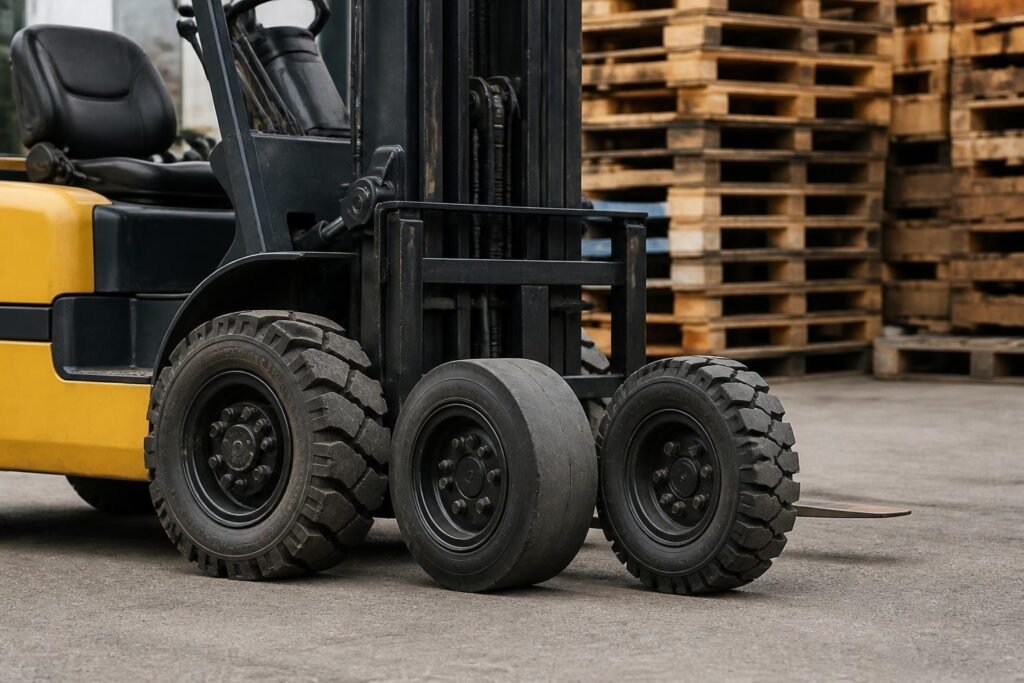
Cushion tires consist of solid rubber pressed directly onto a metal band that fits around the wheel. This simple construction delivers several advantages for smooth-surface applications.
Key characteristics of cushion tires:
- Smaller diameter and narrower profile than other types
- Lower ground clearance ideal for container loading
- Solid construction eliminates puncture risk
- Best suited for smooth concrete or asphalt surfaces
- Lowest initial cost among tire categories
- Tighter turning radius for confined spaces
Cushion tires excel in indoor warehouses, retail distribution centers, and loading docks where forklifts operate exclusively on finished floors. The solid construction transmits more vibration to the operator and chassis, making them less suitable for rough surfaces or extended outdoor use.
Pneumatic Tires: All-Terrain Versatility
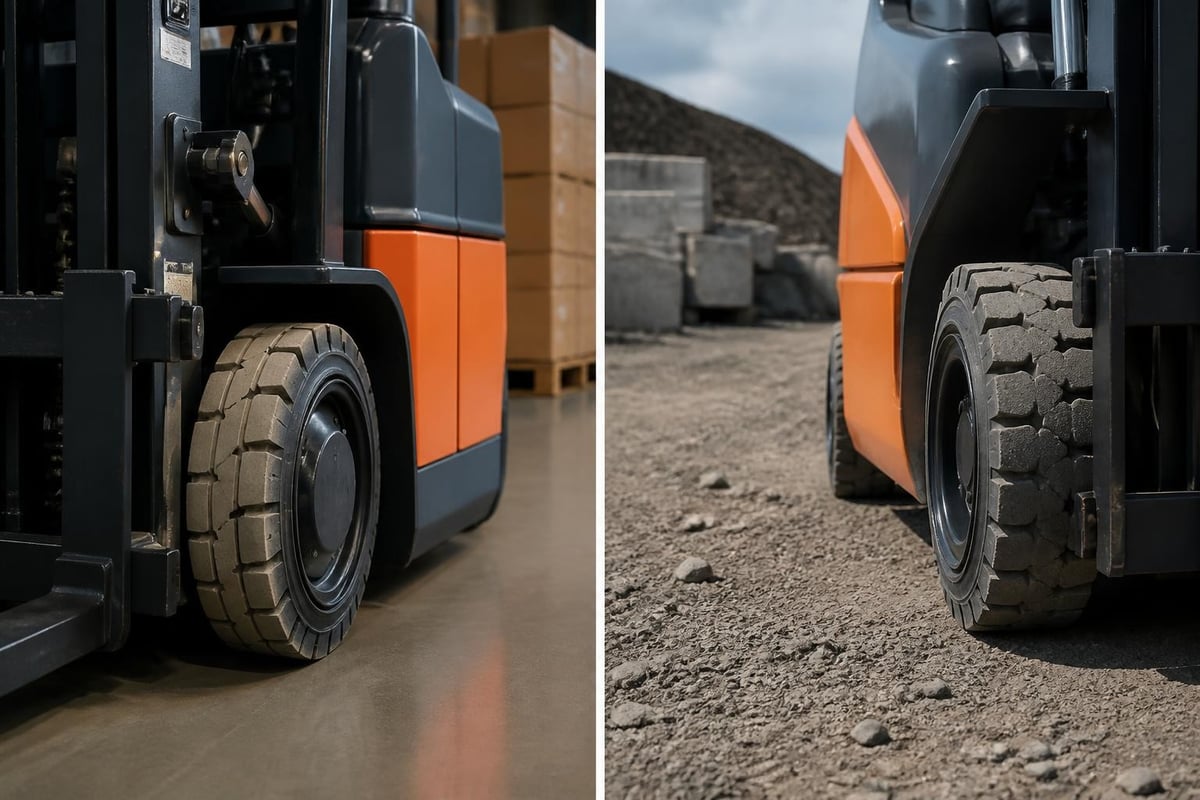
Pneumatic forklift tires mirror automotive tire construction with air-filled inner tubes or tubeless designs. This category subdivides into two distinct variants that serve different operational needs.
Air-filled pneumatic tires provide cushioning through compressed air, delivering superior shock absorption on uneven surfaces. The tread patterns range from shallow ribs for mixed-use to aggressive lugs for outdoor terrain. These tires offer the smoothest ride quality and best traction on loose or wet surfaces.
Solid pneumatic tires use a rubber compound molded to replicate pneumatic tire dimensions without any air cavity. They combine the puncture resistance of cushion tires with the larger footprint and better traction of air-filled pneumatics.
| Feature | Air-Filled Pneumatic | Solid Pneumatic |
|---|---|---|
| Puncture risk | Moderate to high | Very low |
| Ride comfort | Excellent | Good |
| Maintenance | Regular pressure checks | Minimal |
| Outdoor traction | Superior | Very good |
| Service life | 2,000–3,000 hours | 3,000–5,000 hours |
Pneumatic tires suit lumber yards, construction sites, agricultural facilities, and any operation requiring forklifts to transition between indoor and outdoor surfaces regularly.
Solid Tires: Maximum Durability
Solid forklift tires represent the most robust option for harsh environments where punctures and downtime carry significant cost penalties. Modern solid tires use advanced rubber compounds that balance durability with operator comfort.
Manufacturing techniques have evolved considerably. Press-on solid tires attach mechanically to the wheel assembly, while bonded solid tires are chemically adhered during vulcanization. The bonded construction provides superior stability under high-load lateral forces.
Advanced solid tire designs incorporate internal cushioning layers that reduce vibration transmission. Research from the University of Washington demonstrates that tire selection significantly affects whole-body vibration exposure in forklift operators, with implications for long-term musculoskeletal health. Solid tires with engineered damping compounds can reduce operator vibration by fifteen to twenty-five percent compared to basic solid designs.
Solid tires deliver unmatched value in recycling facilities, scrap yards, foundries, and manufacturing plants where sharp debris, metal shavings, or extreme temperatures would quickly destroy pneumatic tires.
Selection Criteria for Optimal Performance
Choosing appropriate forklift tires requires analyzing multiple operational factors beyond simple indoor versus outdoor classification. A systematic evaluation prevents premature wear and costly mismatches.
Operating Surface Assessment
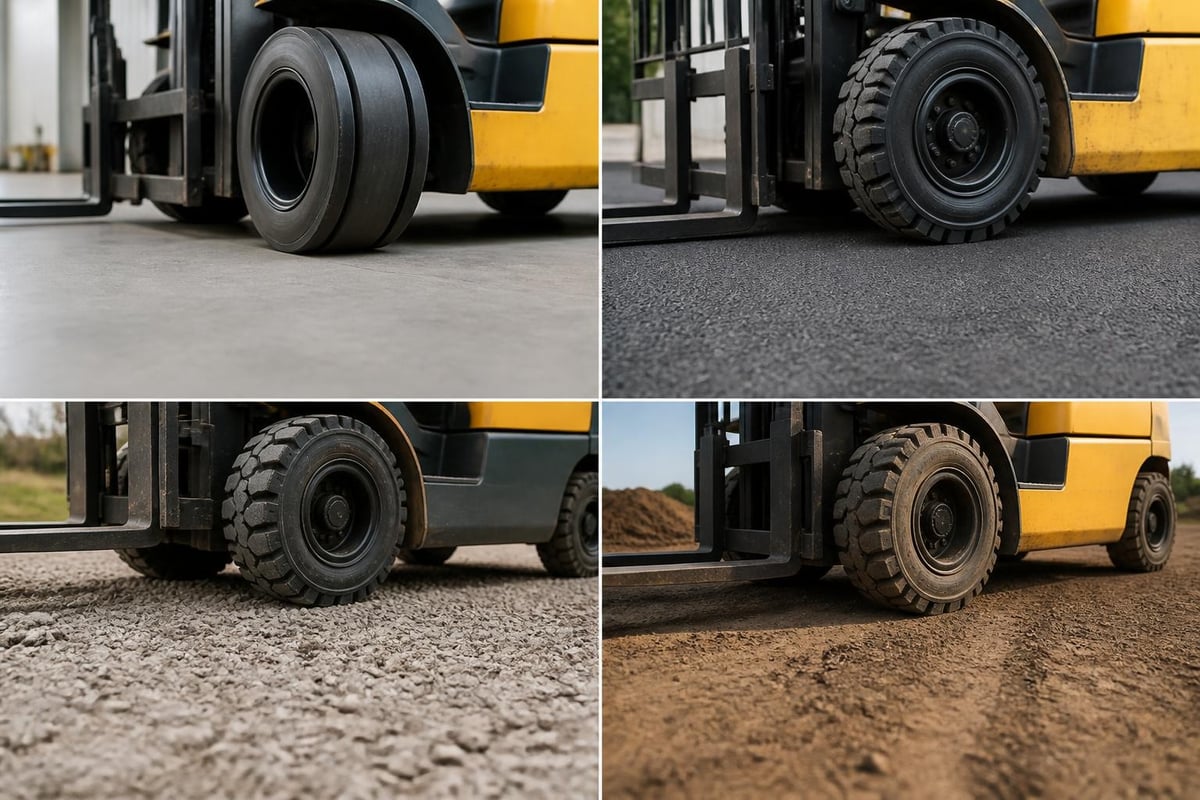
The floor or ground surface dictates tire compatibility more than any other single factor. Smooth, sealed concrete permits cushion tires and maximizes their efficiency advantages. Rough concrete, especially with expansion joints or surface deterioration, demands pneumatic cushioning to prevent excessive vibration and component wear.
Outdoor surfaces introduce additional variables:
- Asphalt in good condition works with any tire type but shows best results with pneumatic tires
- Gravel or crushed stone requires pneumatic tires for adequate traction and stability
- Dirt or grass necessitates aggressive tread patterns available only on pneumatic designs
- Mixed surfaces (indoor/outdoor transitions) favor solid pneumatic configurations
Load Capacity and Distribution
Forklift tires must support not only the equipment's rated capacity but also account for load distribution during lifting and travel. Tire sidewalls display load ratings that must meet or exceed the forklift's rear axle load at maximum lift height.
Critical load considerations:
- Static load when stationary with load elevated
- Dynamic forces during acceleration and braking
- Lateral forces during turning with elevated loads
- Impact loading when traveling over surface irregularities
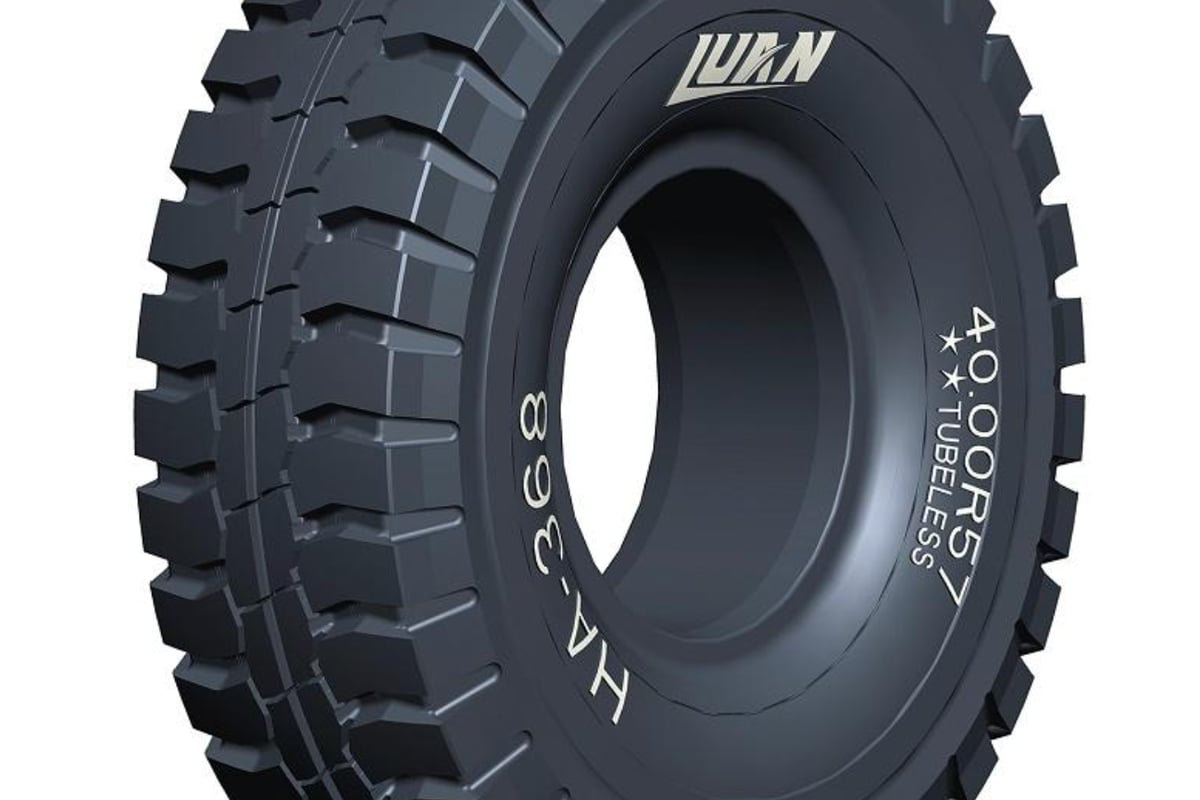
OTR TIRE THAI manufactures industrial and specialty tires engineered to meet demanding load specifications across diverse forklift applications. Their solid tire range provides distributors with factory-direct access to premium compounds designed specifically for high-intensity material handling operations in over eighty countries.
Operational Intensity and Shift Patterns
Single-shift operations with moderate utilization create very different tire demands than continuous multi-shift warehouses. High-intensity distribution centers running three shifts daily prioritize tire longevity and predictable replacement intervals over initial cost.
Usage pattern implications:
| Operation Type | Recommended Tire | Priority Factor |
|---|---|---|
| Single shift, light duty | Cushion (indoor) or air pneumatic | Initial cost |
| Two shifts, moderate duty | Solid pneumatic or cushion | Balance cost/life |
| Three shifts, heavy duty | Bonded solid or premium pneumatic | Maximum uptime |
| Outdoor construction | Air-filled pneumatic with aggressive tread | Traction/durability |
Environmental conditions also influence tire selection. Extreme temperatures, chemical exposure, and contamination concerns may require specialized compounds. Non-marking tires use light-colored rubber formulations for food processing, pharmaceutical, and clean-room applications where black rubber marks are unacceptable.
Maintenance Protocols and Safety Standards
Proper forklift tire maintenance extends service life, prevents accidents, and ensures compliance with occupational safety regulations. Daily pre-operational checks should include tire inspection according to established safety guidelines from occupational health authorities.
Inspection Requirements
Visual inspection identifies developing problems before they cause failures or safety incidents. Operators should examine tires for several critical conditions during daily equipment checks.
Essential inspection points:
- Tread depth remaining (replace at two-inch depth for pneumatic, when wear reaches safety line for solid)
- Sidewall cuts, gouges, or exposed reinforcement materials
- Uneven wear patterns indicating alignment or inflation problems
- Chunking or tearing at tread edges
- Proper inflation pressure for pneumatic tires (check cold, before operation)
- Secure mounting with no looseness or wobble
The UK Health and Safety Executive guidance emphasizes tire condition as part of comprehensive operator training programs. Operators must understand how degraded tires compromise stability and increase tip-over risk, particularly with elevated loads.
Pneumatic Tire Pressure Management
Maintaining correct inflation pressure in air-filled pneumatic tires directly affects performance, safety, and tire longevity. Under-inflation causes excessive heat buildup, accelerated shoulder wear, and reduced load capacity. Over-inflation creates a harsh ride, reduces traction, and makes tires vulnerable to impact damage.
Pressure specifications appear on the tire sidewall or forklift data plate. Check pressure when tires are cold, before operation generates heat that increases internal pressure readings. Many operations implement weekly pressure verification schedules with nitrogen inflation systems that maintain more stable pressure across temperature fluctuations.
Rotation and Replacement Strategies
Systematic tire rotation equalizes wear across all positions, extending overall service life. Front tires typically wear faster due to steering forces and weight distribution during loaded operation. Rotating tires every two hundred operating hours or monthly can increase total service life by fifteen to twenty percent.
Replacement decisions require judgment beyond simple tread-depth measurements. Operational safety standards published in the Federal Register incorporate ANSI/ITSDF B56 series requirements for powered industrial trucks. These standards establish minimum tire condition thresholds that supersede arbitrary replacement intervals.
Replace tires when any of these conditions exist:
- Tread worn to replacement indicators or safety lines
- Visible cord or reinforcement material
- Sidewall damage extending into load-bearing structure
- Chunking exceeding one inch in diameter
- Irregular wear creating more than one-eighth inch variation across tread surface
- Age-related deterioration (cracking, compound hardening) after five to seven years regardless of appearance
Emerging Technologies and Industry Trends
Forklift tire technology continues advancing with new compounds, construction methods, and performance-monitoring systems. Industry publications regularly feature innovations addressing vibration reduction, electrical conductivity for static-sensitive environments, and extended service life.
Vibration Mitigation Technologies
Whole-body vibration remains a significant occupational health concern for forklift operators. The UK Health and Safety Laboratory documented warehouse interventions using specialized tires and suspension seats to reduce measured vibration exposure below action thresholds. Multi-layer solid tires with internal cushioning zones can reduce vibration transmission by thirty percent compared to conventional solid designs.
Premium pneumatic tires now incorporate sidewall damping ribs and optimized tread patterns that minimize road noise transmission. These features matter most in retail distribution centers and indoor facilities where operators spend entire shifts in equipment.
Compound Innovations for Specialized Applications
Modern rubber formulations address increasingly specific operational requirements:
- Electrically conductive compounds prevent static buildup in electronics manufacturing and explosive-atmosphere facilities
- Non-marking formulations in colors beyond standard tan address aesthetic requirements in showrooms and commercial spaces
- Heat-resistant compounds withstand foundry and steel mill temperatures exceeding two hundred degrees Fahrenheit
- Oil-resistant materials maintain integrity in automotive and petroleum industry applications
- Low-rolling-resistance designs reduce energy consumption in electric forklift fleets
Predictive Maintenance and Monitoring
Fleet management systems increasingly incorporate tire condition monitoring through RFID tags, pressure sensors, and wear-measurement systems. These technologies enable data-driven replacement decisions that optimize total cost of ownership rather than relying solely on visual inspection or arbitrary intervals.
Automated monitoring identifies individual tires requiring attention before failures occur, reducing unplanned downtime. Integration with maintenance management software creates complete lifecycle records supporting warranty claims and vendor performance analysis. Large distribution operations report ten to fifteen percent reductions in tire-related downtime after implementing digital monitoring systems.
Cost Analysis and Total Ownership Considerations
Purchase price represents only one component of true forklift tire costs. Comprehensive analysis must account for service life, maintenance requirements, downtime impact, and replacement labor across the tire's operational lifespan.
Comparative Lifetime Economics
Initial pricing varies significantly across tire categories, but service life differences alter the economic calculation substantially.
| Tire Type | Typical Cost per Tire | Average Service Hours | Cost per Operating Hour |
|---|---|---|---|
| Cushion | $150–$300 | 2,000–2,500 | $0.08–$0.15 |
| Air pneumatic | $200–$400 | 2,000–3,000 | $0.08–$0.20 |
| Solid pneumatic | $400–$700 | 3,000–5,000 | $0.10–$0.18 |
| Premium bonded solid | $600–$1,000 | 4,000–6,000 | $0.12–$0.20 |
These figures illustrate why operations with intensive multi-shift utilization often achieve lower total costs with premium solid tires despite higher initial investment. Single-shift operations with lower annual hours may optimize costs with cushion or standard pneumatic tires.
Hidden Cost Factors
Tire-related expenses extend beyond purchase and installation. Comprehensive cost accounting includes several often-overlooked elements:
Maintenance labor requirements vary dramatically. Pneumatic tires demand regular pressure monitoring and periodic replacement of punctured tubes. Solid tires eliminate these tasks entirely. Labor savings can reach two to three hours monthly per forklift in large fleets.
Downtime costs from tire failures or scheduled replacements compound in high-throughput operations. Each hour of forklift unavailability translates directly to delayed shipments, reduced picking capacity, or idle labor. Operations should calculate their hourly forklift utilization value when comparing tire options.
Safety incidents from tire-related equipment instability create costs in injury treatment, workers' compensation premiums, regulatory compliance, and potential litigation. Premium tires with superior stability characteristics provide insurance against these exposures.
Energy consumption differs measurably across tire types. Cushion tires typically offer the lowest rolling resistance on smooth surfaces, while pneumatic tires require more energy to maintain motion. Electric forklift operations should factor energy costs at their local commercial rates when evaluating tire options.
Regulatory Compliance and Documentation
Workplace safety regulations in most jurisdictions mandate systematic forklift maintenance including tire inspection and timely replacement. Documentation requirements create audit trails demonstrating compliance with occupational safety standards.
Inspection Record Systems
Formal pre-shift inspection checklists should include specific tire condition criteria with pass/fail determinations. Digital inspection systems capture timestamps, operator identification, and photographic evidence of tire conditions. These records prove invaluable during regulatory inspections or accident investigations.
Many operations implement tiered inspection protocols with daily operator checks supplemented by weekly detailed examinations by maintenance personnel. The weekly inspection includes precise tread-depth measurements, pressure verification, and documentation of any developing wear patterns requiring monitoring.
Replacement Decision Authority
Clear policies should establish who has authority to remove equipment from service based on tire condition. Operators must have both the training to recognize unsafe conditions and the organizational support to report concerns without productivity pressure overriding safety judgment.
Maintenance supervisors typically make final replacement decisions using objective criteria documented in standard operating procedures. Consistent application of wear limits prevents premature replacements that waste tire life while ensuring removal before safety margins erode.
Selecting and maintaining appropriate forklift tires requires balancing operational demands, economic constraints, and safety requirements across diverse material handling environments. Whether your operation needs cushion tires for smooth warehouse floors, pneumatic tires for outdoor versatility, or premium solid tires for maximum durability in harsh conditions, the right choice directly impacts productivity and total cost of ownership. OTR TIRE THAI manufactures a comprehensive range of forklift tires and industrial specialty tires designed to meet international quality standards, offering distributors factory-direct wholesale pricing backed by proven performance across more than eighty countries. Contact our technical team today to discuss tire specifications that match your specific operational requirements and fleet characteristics.
