
Blog
Solid Tyres: Complete Guide for Industrial Applications
Sep
Industrial operations demand equipment that performs reliably under the harshest conditions. When downtime costs thousands of dollars per hour and safety remains paramount, choosing the right tyres for material handling and heavy equipment becomes a critical business decision. Solid tyres have emerged as the preferred solution for warehouses, manufacturing plants, construction sites, and distribution centers where puncture resistance and consistent performance outweigh the comfort advantages of pneumatic alternatives. Understanding the engineering principles, application requirements, and total cost of ownership helps fleet managers and procurement teams make informed tyre investment decisions that directly impact operational efficiency and bottom-line profitability.
Engineering and Construction Fundamentals
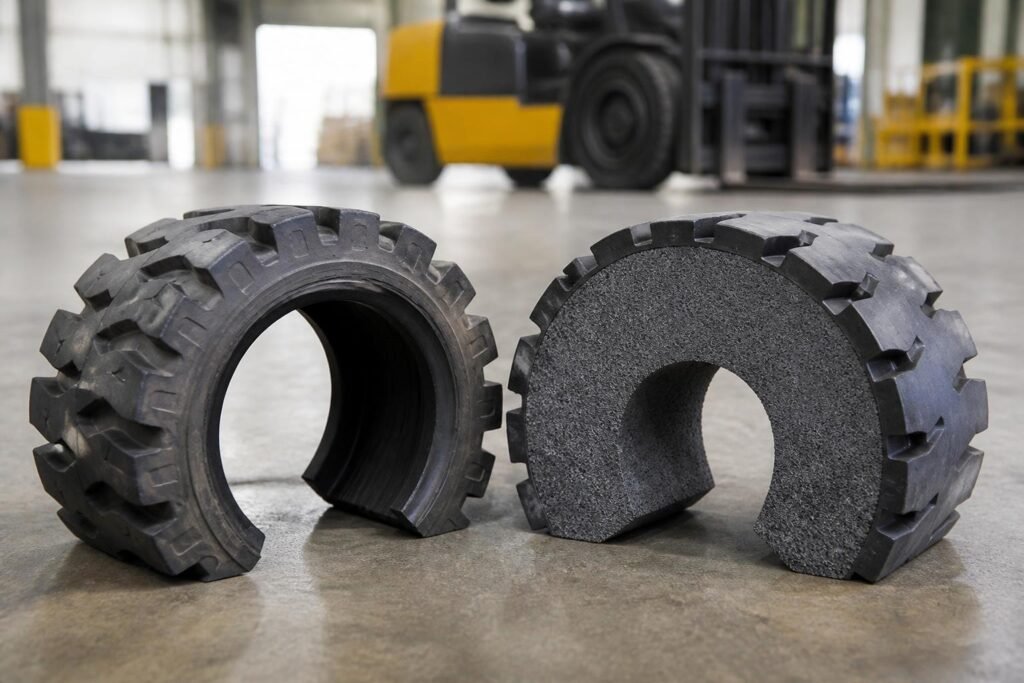
Solid tyres represent a distinct category in the tyre classification system defined by international standards organizations. Unlike pneumatic tyres that rely on compressed air for load support and cushioning, solid tyres use dense rubber compounds throughout their entire cross-section.
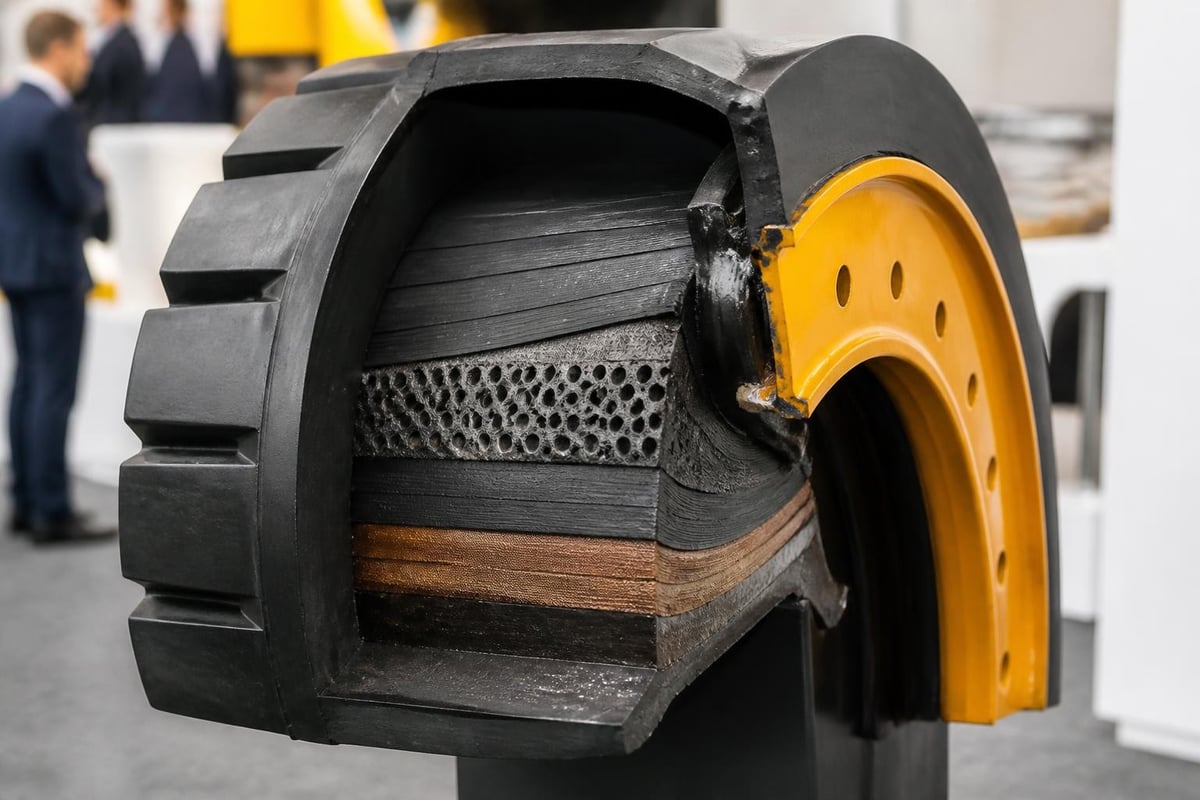
The construction begins with specialized rubber formulations designed to balance firmness with resilience. Manufacturers blend natural and synthetic rubbers with reinforcing agents, antioxidants, and other additives to achieve specific performance characteristics. The resulting compound must withstand continuous compression cycles while resisting cuts, tears, and chemical degradation.
Material Science and Compound Development
Modern solid tyres incorporate advanced polymer chemistry that significantly improves upon earlier designs. Research published in comprehensive materials studies demonstrates how compound optimization affects load capacity, heat dissipation, and service life.
Engineers select specific rubber grades based on the intended application:
- Standard compounds for general warehouse use and smooth concrete floors
- Non-marking formulations for clean environments and retail spaces
- Heat-resistant blends for high-temperature foundries and steel mills
- Chemical-resistant compositions for exposure to oils, solvents, and acids
- Cut-resistant materials for construction debris and sharp object environments
The vulcanization process chemically cross-links polymer chains, creating a three-dimensional molecular network that provides mechanical strength and elastic recovery. Temperature, pressure, and curing time are precisely controlled to ensure consistent properties throughout the tyre volume.
Application Environments and Performance Requirements
Solid tyres excel in specific operational contexts where their unique characteristics provide measurable advantages. Understanding these application parameters helps organizations determine when solid tyres deliver optimal value compared to pneumatic or cushion alternatives available from specialized tyre manufacturers.
Material Handling Equipment
Forklifts operating in demanding environments benefit most from solid tyre technology. Distribution centers running multi-shift operations prioritize uptime over ride comfort. The Toyota Forklifts technical replacement guide provides specific recommendations for solid tyre selection based on load capacity, operating surface, and duty cycle intensity.
Electric forklifts in indoor warehouses typically run solid tyres on smooth concrete, where puncture elimination outweighs the slightly firmer ride. Counterbalance trucks lifting heavy pallets appreciate the lateral stability that solid construction provides during turning maneuvers.
| Equipment Type | Typical Application | Primary Solid Tyre Benefit |
|---|---|---|
| Electric Forklift | Indoor warehouse | Zero puncture downtime |
| IC Forklift | Lumberyard, outdoor | Debris resistance |
| Reach Truck | Narrow aisle | Stable high lifting |
| Pallet Jack | Loading dock | Long service life |
| Tow Tractor | Airport, assembly | Continuous operation |
Construction and Industrial Sites
Skid steers, compact loaders, and industrial vehicles operating in construction zones encounter nails, metal scraps, glass shards, and sharp rocks that would quickly disable pneumatic tyres. Solid tyres eliminate this vulnerability entirely, maintaining operational readiness throughout the workday.
Mining operations, steel mills, and recycling facilities present extreme conditions. High temperatures from furnace areas, corrosive chemicals from industrial processes, and continuous heavy loads demand tyres engineered for punishment. When evaluating when solid tyres outperform pneumatic alternatives, these harsh environment applications top the list.
Performance Characteristics and Trade-offs
Every tyre technology involves engineering compromises. Solid tyres optimize for certain performance parameters while accepting limitations in others. Quantifying these trade-offs enables data-driven procurement decisions aligned with operational priorities.
Load Capacity and Stability
Solid construction provides exceptional load-bearing capability relative to tyre size. The dense rubber mass distributes weight across a larger contact patch without the risk of pressure loss that affects pneumatic tyres. This characteristic proves particularly valuable for heavy-duty forklifts moving dense loads like steel coils, automotive parts, or building materials.
Lateral stability during cornering improves because solid tyres maintain consistent contact geometry regardless of load variation. Pneumatic tyres deflect and deform under side loads, potentially compromising handling precision. For operations requiring tight maneuvering in congested aisles, this stability advantage translates to improved operator confidence and faster cycle times.
Heat Generation and Dissipation
Continuous flexing generates internal heat through hysteresis, the energy lost during rubber deformation cycles. Solid tyres produce more heat than pneumatic designs because compression occurs throughout the tyre volume rather than being absorbed by air cushioning.
Manufacturers address heat management through several approaches:
- Aperture patterns create internal air pockets that reduce solid mass
- Compound formulations minimize hysteretic losses through polymer selection
- Operational guidelines specify maximum speed and duty cycle limits
- Heat-resistant materials maintain properties at elevated temperatures
Fleet managers must match tyre specifications to actual operating conditions. High-speed applications or continuous-duty cycles may exceed heat dissipation capabilities, requiring either tyre redesign or operational adjustments.
Maintenance Requirements and Service Life Economics
The total cost of ownership calculation extends beyond initial purchase price to encompass installation labor, maintenance requirements, downtime costs, and replacement frequency. Solid tyres fundamentally alter this economic equation compared to pneumatic alternatives.
Installation and Replacement Procedures
Mounting solid tyres requires specialized hydraulic press equipment and trained technicians. The interference fit between tyre and rim demands considerable force, making roadside changes impossible. This installation complexity represents both an initial barrier and a long-term advantage.
Once properly installed, solid tyres remain maintenance-free throughout their service life. No inflation checks, no pressure adjustments, no leak repairs. This elimination of routine maintenance reduces labor costs and simplifies fleet management, particularly for organizations operating large forklift fleets across multiple facilities.
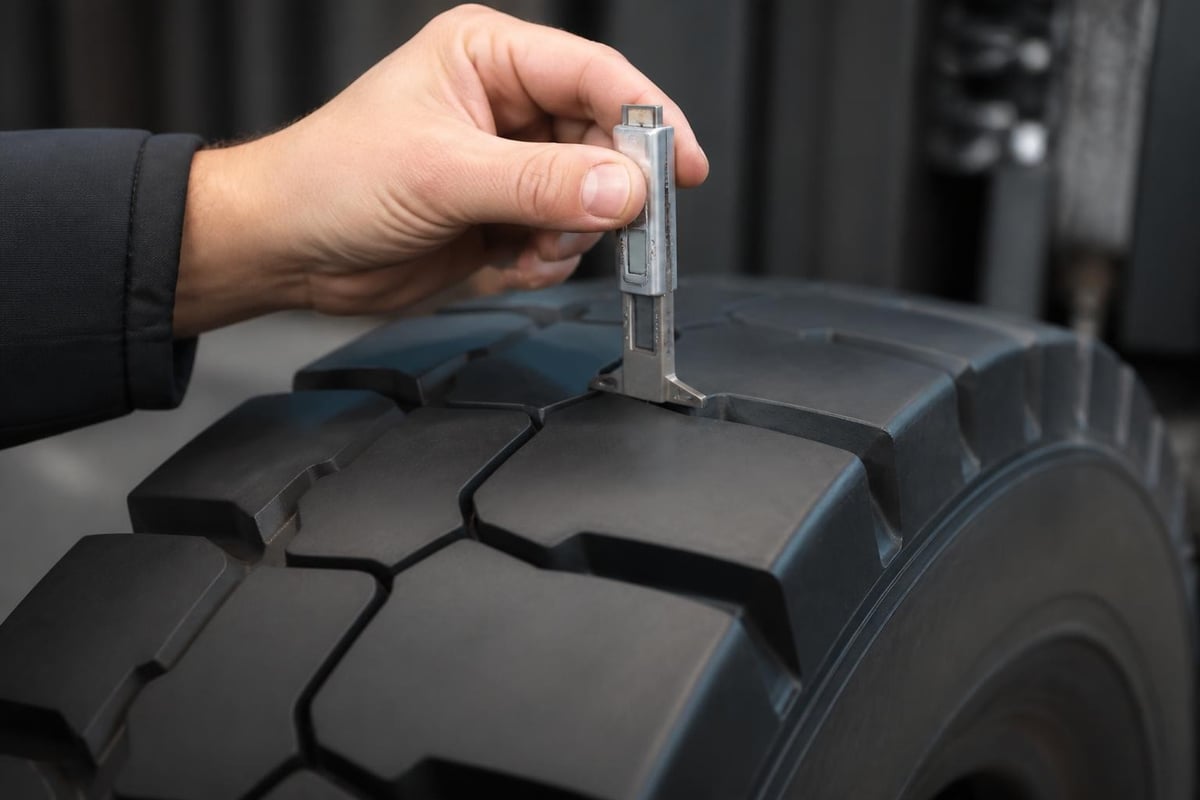
The ETRTO standards document specifies inspection criteria and end-of-life indicators for solid tyres. Wear limits are typically reached when tread depth reduces to specific measurements or when the tyre shoulder shows particular degradation patterns. Unlike pneumatic tyres that can fail suddenly, solid tyres provide visual warning of approaching replacement needs.
Service Life Duration and Predictability
Solid tyres routinely deliver two to three times the operating hours of comparable pneumatic tyres in appropriate applications. Distribution centers commonly report 12,000 to 15,000 hours of service from quality solid tyres on electric forklifts, compared to 4,000 to 6,000 hours for pneumatic alternatives.
This extended service life results from several factors:
- No puncture failures that prematurely end tyre life
- Consistent load distribution without pressure variation
- Robust construction resistant to cuts and impacts
- Predictable wear patterns enabling scheduled replacement
Organizations can integrate solid tyre replacement into planned maintenance windows rather than responding to unexpected failures. This predictability improves budget forecasting and reduces emergency service calls that disrupt operations.
Specialized Variants and Advanced Technologies
The solid tyre category encompasses diverse designs optimized for specific requirements beyond standard industrial applications. Recent innovations address traditional limitations while expanding suitable use cases.
Aperture and Cushion Hybrid Designs
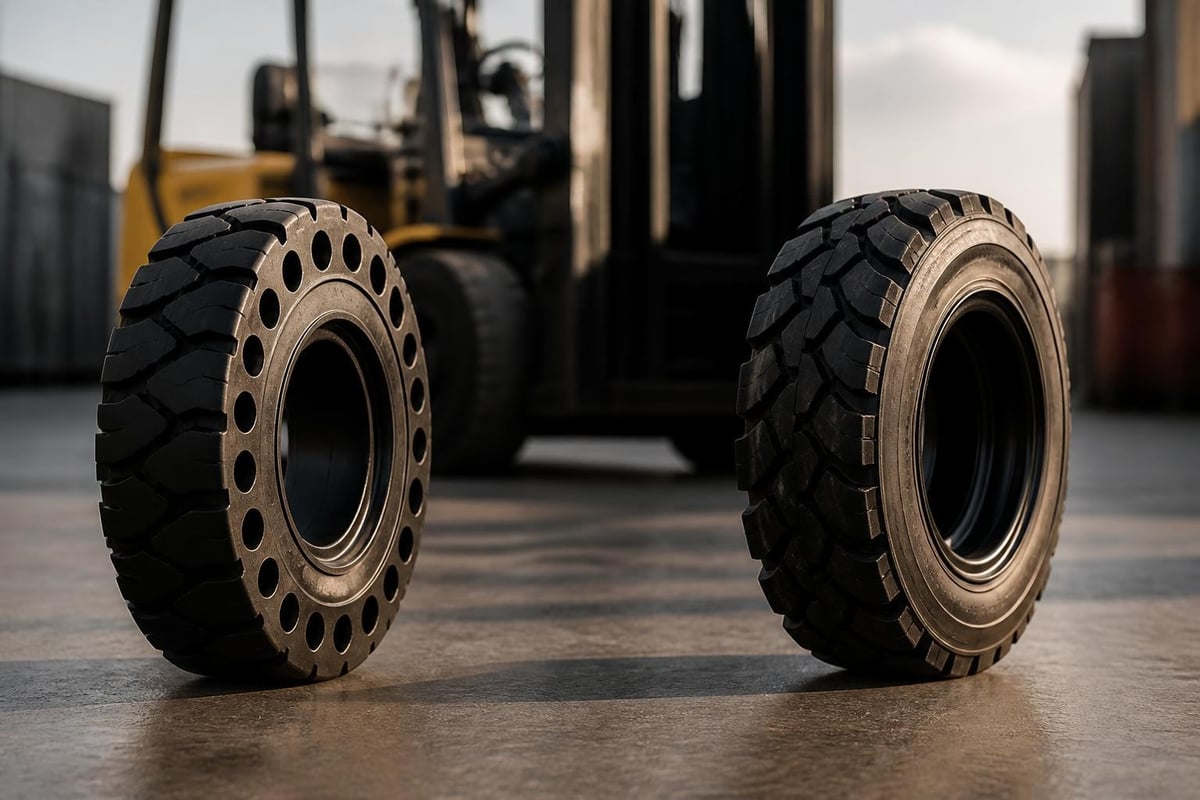
Modern solid tyres often incorporate aperture patterns, strategic voids within the rubber mass that provide limited cushioning while maintaining puncture immunity. These apertures reduce weight, improve heat dissipation, and soften ride quality compared to fully solid construction.
Press-on band tyres represent another variation, featuring a solid rubber tread bonded to a metal band that presses onto a flat wheel rim. This design facilitates easier installation and removal compared to traditional solid tyres while delivering similar performance benefits.
| Tyre Type | Installation Method | Ride Comfort | Typical Application |
|---|---|---|---|
| Solid | Hydraulic press | Firm | Heavy-duty warehouse |
| Aperture | Hydraulic press | Moderate | Multi-surface operation |
| Press-on band | Mechanical press | Firm | Smooth floor warehouse |
| Cushion | Mechanical press | Good | Mixed indoor/outdoor |
Non-Marking and Specialty Compounds
Retail environments, food processing facilities, and clean manufacturing spaces require tyres that won't leave black marks on floors. Non-marking solid tyres use specialized compounds, typically light-colored, that eliminate the carbon black filler found in standard rubber formulations.
These compounds maintain adequate durability while meeting cleanliness requirements, though they generally cost more and may have slightly reduced load capacity compared to standard black compounds. The premium pricing reflects both specialized materials and smaller production volumes.
Chemical resistance becomes critical in industrial environments exposing tyres to oils, solvents, acids, or other aggressive substances. Manufacturers formulate specific compounds resistant to degradation from these chemicals, extending service life in applications that would rapidly destroy standard rubber.
Environmental Considerations and Sustainability
The environmental impact of tyre manufacturing, use, and disposal has gained increasing attention from regulatory agencies and corporate sustainability initiatives. The EPA’s ongoing research into tyre-related environmental and health impacts influences industry practices and future development directions.
Material Sourcing and Manufacturing Impact
Solid tyres require significantly more raw material per unit than pneumatic tyres of equivalent size, increasing the environmental footprint of production. Natural rubber harvesting, synthetic rubber synthesis from petroleum feedstocks, and the energy-intensive vulcanization process all contribute to manufacturing emissions.
However, the extended service life partially offsets this initial impact. A solid tyre operating for 12,000 hours replaces two or three pneumatic tyres over the same period, reducing total material consumption and manufacturing emissions per operating hour.
End-of-Life Management and Recycling
Recycling solid tyres presents technical challenges due to their dense, heavily cross-linked rubber structure. Traditional tyre recycling processes designed for pneumatic tyres may require modification to handle solid tyre volumes effectively.
Current disposal pathways include:
- Mechanical grinding into crumb rubber for playground surfaces and running tracks
- Pyrolysis processes that thermally decompose rubber into oils, gases, and carbon black
- Energy recovery through combustion in cement kilns and power generation
- Retreading programs for certain solid tyre designs with adequate remaining carcass integrity
Progressive manufacturers are exploring bio-based compounds and recyclable materials to improve sustainability metrics. As circular economy principles gain traction, expect increased focus on designing solid tyres for easier end-of-life processing and material recovery.
Selection Criteria and Specification Guidelines
Choosing appropriate solid tyres requires systematic evaluation of operational requirements, equipment specifications, and performance priorities. A structured selection process prevents costly mismatches between tyre capabilities and application demands.
Load and Speed Rating Analysis
Begin with precise equipment specifications. Forklift capacity plates indicate maximum load and operating speed limits. Solid tyres must provide adequate load rating with appropriate safety margin, typically 25-30% above maximum anticipated loads.
Speed ratings become critical for applications involving extended travel distances or higher operating speeds. Solid tyres generate more heat than pneumatic alternatives, making speed limitations more restrictive. Exceeding manufacturer speed ratings accelerates wear and risks premature failure through heat-related degradation.
Organizations running telematics-equipped commercial fleets can leverage actual operational data to inform tyre selection. Speed profiles, load distributions, and duty cycles extracted from telematics systems provide objective evidence supporting specification decisions rather than relying on estimated usage patterns.
Surface Conditions and Operating Environment
Floor surface characteristics directly impact tyre performance and longevity. Smooth, sealed concrete provides ideal conditions for solid tyres, minimizing rolling resistance and wear rates. Rough surfaces, expansion joints, and uneven pavement increase stress and accelerate tread consumption.
Outdoor operations introduce additional variables. Temperature extremes affect rubber properties; cold temperatures reduce flexibility while high heat accelerates degradation. Exposure to sunlight, ozone, and weather requires UV stabilizers and environmental resistance built into the compound formulation.
Consider these environmental factors during specification:
- Indoor warehouse: Standard compound, optimized for smooth concrete
- Outdoor yard: Weather-resistant compound, robust tread pattern
- Mixed use: Compromise compound balancing indoor/outdoor requirements
- Extreme temperature: Specialized formulation maintaining properties across temperature range
- Chemical exposure: Resistant compound specific to chemical types present
Solid tyres designed for industrial material handling often complement other specialized products in comprehensive tyre lineups. Distributors seeking complete solutions for diverse fleet requirements can explore various tyre categories that address everything from passenger vehicles to agricultural equipment and heavy-duty trucks.
Cost-Benefit Analysis Framework
Quantifying the financial impact of solid tyre implementation requires comprehensive analysis extending beyond sticker price comparison. A complete cost-benefit framework captures all relevant expense categories and operational impacts.
Initial Investment Considerations
Solid tyres typically cost two to four times more than pneumatic equivalents in terms of unit purchase price. This significant premium often triggers initial sticker shock during procurement discussions. However, isolated price comparison ignores the broader economic equation.
Installation costs must be factored into initial investment. Solid tyre mounting requires hydraulic press equipment and skilled labor, potentially adding $50-150 per tyre in labor charges depending on size and local rates. Organizations lacking in-house press equipment may need capital investment or must outsource installation to authorized service centers.
| Cost Category | Pneumatic Tyre | Solid Tyre | Notes |
|---|---|---|---|
| Unit purchase price | $250-400 | $600-1,200 | Varies by size and brand |
| Installation labor | $25-50 | $75-150 | Solid requires press equipment |
| Expected service hours | 4,000-6,000 | 12,000-15,000 | Application-dependent |
| Cost per 1,000 hours | $48-75 | $50-75 | Including purchase + installation |
Operational Cost Savings
The elimination of puncture-related downtime delivers substantial value in high-utilization environments. A single forklift failure during peak operations can idle multiple workers, delay shipments, and disrupt production schedules. Quantifying downtime costs requires calculating:
- Direct labor costs for idle operators and affected workers
- Lost productivity measured in missed picks, delayed shipments, or production shortfalls
- Emergency service charges for unplanned tyre replacement or repair
- Overtime expenses incurred catching up on delayed work
Conservative estimates place forklift downtime costs at $100-300 per hour when accounting for all impacts. A distribution center experiencing just two puncture failures per month saves $2,400-7,200 annually per forklift by eliminating this downtime through solid tyre implementation.
Maintenance labor reductions provide additional savings. Pneumatic tyres require regular pressure checks, periodic inflation adjustments, and occasional leak repairs. Solid tyres eliminate these tasks entirely, freeing maintenance staff for other responsibilities. For a 50-forklift fleet, this might represent 100-150 annual labor hours saved.
Future Development Trends and Innovation
Solid tyre technology continues evolving through materials science advances, manufacturing process improvements, and application-specific design optimization. Several development trends are reshaping the category and expanding suitable applications.
Advanced Material Systems
Research into thermoplastic elastomers and polyurethane compounds offers potential performance improvements over traditional vulcanized rubber. These materials provide enhanced resilience, superior cut resistance, and better heat dissipation properties. Manufacturing advantages include simpler processing and potential recyclability benefits.
Nano-scale reinforcement fillers represent another innovation frontier. Carbon nanotubes, graphene, and other nano-materials strengthen rubber compounds at molecular levels, potentially enabling thinner, lighter solid tyres with equivalent or superior performance compared to current designs.
Smart Tyre Integration
Embedding sensors within solid tyres enables condition monitoring and predictive maintenance capabilities. Temperature sensors detect abnormal heat buildup indicating excessive speed or overloading. Wear sensors provide precise remaining service life data, optimizing replacement timing and inventory management.
These smart tyre systems integrate with fleet management platforms and telematics infrastructure, providing real-time visibility into tyre health across entire equipment populations. Early warning of developing issues prevents unexpected failures and enables proactive intervention.
Application Expansion
Traditionally limited to low-speed industrial equipment, improved solid tyre designs are gradually expanding into higher-speed applications. Airport ground support equipment, port terminal tractors, and certain construction vehicles now successfully operate solid tyres in roles previously requiring pneumatic alternatives.
This expansion reflects both material improvements enabling higher speed capabilities and operational recognition that total cost advantages justify accepting certain performance trade-offs in appropriate contexts.
Solid tyres deliver unmatched durability and operational reliability for material handling equipment and industrial vehicles operating in demanding environments where puncture resistance and low maintenance outweigh ride comfort considerations. Understanding application requirements, properly specifying tyre characteristics, and conducting comprehensive cost-benefit analysis enables organizations to leverage solid tyre advantages for measurable operational and financial improvements. As a leading manufacturer serving distributors across 80 countries, OTR TIRE THAI provides premium solid tyres alongside comprehensive industrial and specialty tyre solutions backed by international quality standards and competitive wholesale pricing.
